Wednesday, April 16, 2008

look kids!

Well, even with everything else, I turned in, a few hours ago, my final MFA manuscript, title: libido register.

What remains of this degree at Pitt are: 1 seminar paper, on Henry James and Nate Hawthorne and affective relations to real in the novelistic art, 80 7-page papers on the Civil War to grade. Estimated completion date: about a week. Then, beware of 'certified' poets lurking at Kalamazoo...

I realize that this is the closest thing to a picture of myself that I have yet provided for anyone reading my blog, but this is the sheet of committee approval signature for the Ms:


Monday, April 7, 2008

julie granum

I am not entirely sure how I feel about doing my mourning on the internet. But, I need to say--if I believe at all in the value of this electronic-textual community as anything resembling that of a utopian hope--that I am. My friend Julie Granum, a poet in my program at the University of Pittsburgh, died last week in an an accident. I want to name her here.

The literary magazine Whiskey & Fox has published an obituary here: http://whiskeyandfox. blogspot.com

Monday, March 31, 2008

news on my future

So, friends. It will be official as soon as the institution receives my 'official' response in the mail, that when I finish this MFA thing next month I will not be done being a student, in those official institutional capacities. Instead, I will go to New York and undertake a Ph.D. at NYU.

I really have to say, I think NYU and I will get along just fine. I am happy to get to work with a number of new colleagues and the NYU faculty, having met at least one of them (of the student variety) already electronically by means of the folks over at ITM .

Sunday, January 20, 2008

Hawthorne, Romancing Unreality

I have been reading Hawthorne lately. Its for a Henry James seminar, with a bit of a comparative edge (Balzac, Flaubert, etc.). In the process of this reading of The Blithedale Romance for the seminar, and James' book on Hawthorne, I was reminded of Hawthorne as one of the first authors I read and subsequently fell in love with--one of those fabled first literary loves around the high school age. I have, as such, thought a bit about this--connecting the pleasure of this to the fact that Hawthorne is notoriously not a 'realist'--a point on which James harps again and again--and does not pay much attention to class; being much more that famous American (and I use the modifier as another potential strike against him) provincial "Romancer" interested in 'airy' things and ghost stories and all of that which might come to be all-too-hastily strewn aside from the shelf of the leftist (nominally US citizen) critic or poet as not an adequate resource for thinking about the problems of the present.

But, on further reflection, It has occurred to me the potential importance of the Romance as a genre with which would want to dialogically stage an encounter with that beast 'realism'--whether that means the cynical exposé of money in Balzac or the cruel streets that swallow up Crane's 'Maggie,' or the belief in the political and revolutionary expediency of representing the realties of labor, capital, and class in relation and conflict as advocated by now those famous (and now also a little too easily digestible and contained within Verso's helpful but necessarily truncated collection of them) debates of the Frankfurt school. That is, I think that Romance as a genre, as a genre I want to claim as a genre, might allow readings in which reality, selfhood, individuality, and basic platonic assumptions about truth and appearance are disarticulated from themselves. All of Hawthorne's deceptive airiness (as outlined from his earliest famous critics like Melville and later Lawrence) serves not simply to suggest than things are not as they appear and that one must look behind, or deeper or whatever truth-as-sight appearancevstruth theory your caught inside. Hawthorne's reality is a conjured one in which you can never tell, ever, if a thing is happening, if a mysterious and evil effect is being worked, as the result of a machine or a science or a pseudo-science or a spirit or a devil or all of the above because all of the above are somehow part of the same system or other misguided Emersonian 'Nature.' The 'truth' of Hawthorne's Romances is dissimulation, and their effect is not a reassurance of recognition, or one's direct and holy spiritual continuity with the world, but the spectral rupture, the experience of unreality. The begin their affective work in the way of all manner of thing which can bear a terrible effectivity being neither living nor dead. This is to say, that at moments, Hawthorne's more ghostly moments evoke/conjure the figure of the Derridean ghost, or that ability to produce effects without having being. The airiness in Hawthorne is not a Platonic or symbolist kind of 'more real' reality in pneumatic things, but rather a gray pale fading away of Being.

Hawthorne is a Romancer, of course, because disenchantment can be deceptively enchanting. Romance can be so useful, in that, in cutting (according to Foucault, what knowledge is for) its ties with the accountability of realistic representation it opens the world to the realities of ghostly 'reals' as dissimulations, along with all there 'bewitching' possibilities. While admitting, in the cutting, that, in a sense, as Auden taught, "Poetry makes nothing happen," Romance considers the possibility of affecting the reader's experience of reality rather than representing it.

Wednesday, December 12, 2007

semester's [almost] end: montage

companion animals that are technically not yours are essential to the graduate student. the one featured below is named friday. he's a cat.


Saturday, December 1, 2007

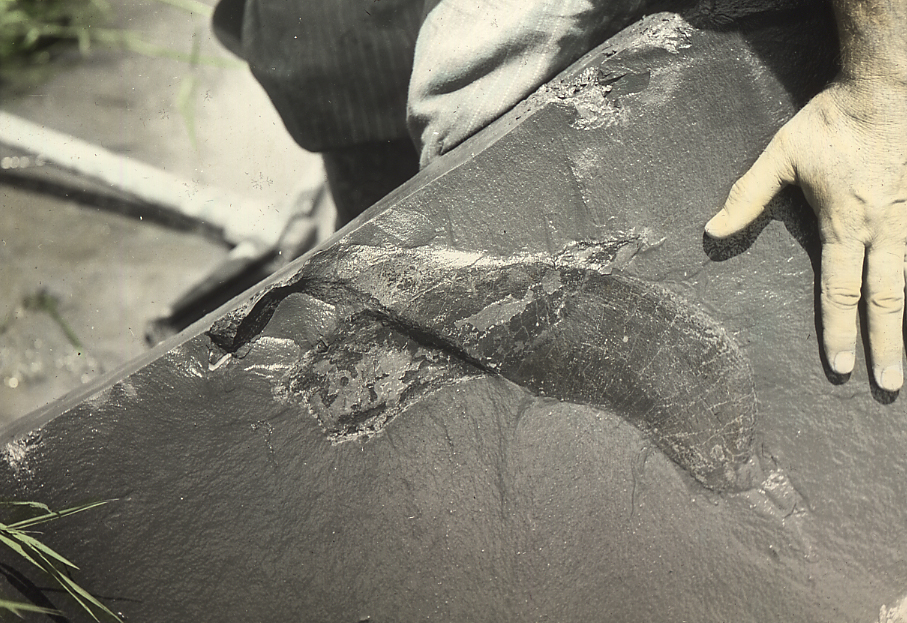
Dinichthys.


So, as there was a long gap between my last two posts, and they were both sort of, well, lets be honest, aiming for a certain kind of gravitas--an aim that's apt to miss--, I thought I would say a few words about the image accompanying my profile and, in part, the right side of your screen.

This is image is from a set of images I found on the Case Western University website, in the geology department. The set of images concerns the geology--both in terms of rocks but also archeological excavation--of a large portion of Ohio.

I grew up in Cleveland.

A place in Cleveland I went sometimes when I was young, with my parents, was the interpretive center of the Rocky River Metroparks. This is a chain of parks with trails and recreation areas which forms a discrete "Emerald Necklace"--as its called--around Cleveland and Cuyahoga country. A shallow, swift, river, flanked by large shale cliffs runs through portions of the park and empties into Lake Erie:


All of this was once under water. During the Pre-Cambrian era, all of this was covered by a shallow, inland salt sea. (This is the point where I recite what I still learned from trips to the interpretive center. Somehow, as a child, I was completely enthralled with the the deep time of my hometown). One of the inhabitants of this sea was a creature we now call a Dinichthys. This was a sort of armored fish: a bit shark-like. In the interpretive center, as a child, I was simultaneously terrified and fascinated by a cast of a fossil of a whole Dinichthys which was hung from wire from the ceiling.

The photo to your right, and in my profile, includes a bit of shale from the cliffs of the Rocky River (yes, I know, the name is funny, and descriptive) containing the fossil of a jaw bone from a Dinichthys.

Friday, November 30, 2007

T.S. Eliot and history as fetish

This is bit, extended a smidgen and adapted for being out-of-context, currently leading off the project outlined below in "a sample of current labors."


From “an old man in a dry month” in T.S. Eliot’s “Gerontion”— from this homophobic and anti-Semitic voice, who fears the sexual virility and spiritual (un)orthodoxy of “Christ the Tiger” coming “in the juvenescence of the year”—, from him we read, “Think now/ History has many cunning passages, contrived corridors/ And issues, deceives with whispering ambitions/ guides us by vanities.” To this man, and perhaps to Eliot, this is a horror (although perhaps Eliot is only horrified that this man cannot negotiate such passages and make something Historical of his modernity). History is perhaps most obviously implicated in an implied metaphor of a town, or city, or fortress, or dungeon (complete with issues of sewage). To be deceived or stuck or lost or fixated at any one dank and dead corner would be awful. But, shift the image only slightly from its direct context, and this History can be read as a part or whole of a lover’s body, or even as a fetish-object when we might admit the text or History, and texts in their historicity, as potentially exerting a gravitational pull on the erotic and queer-loving affects of an historiographer. What I am trying to write about these days, is my thinking about the poem “Wulf and Eadwacer” in and as such a history that might be queerly, physically, loved and explored and touched. That is, I am making a statement of desire for “Wulf and Eadwacer,” and exploring what that means, on what it is predicated, and what risks are involved—when we link a potential way of writing history as an event of touching (that is, feeling the texture of the past)—an event of erotic pleasure, and if that pleasure might be thought as the ground of justice—of a kind of history- writing beyond the mimetic economy.

The image taken from Eliot and looked at with squinted eyes perhaps appears as the rectum of history, the penis, or the vulva of history with their corridors and issues, as the metaphor extends—or as a queerly ‘incomplete’ part or body: the corridors as a fetish or a deferral to linger on or in: to feel in a manner that provokes contemporary sexualities. This would elicit a practice of reading, a historiography, as a poetics. That is to say, a writing interested in provoking events (in the way that Caputo’s poetics of the kingdom provoke, in the manner intentionally analogous to Derrida’s future-oriented take on negative critique in Specters of Marx), not producing/representing knowledge. Exploring and lingering in these corridors, these issues, one may be deceived as to one’s location in space and time. But, what is important is not an accurate ability to produce exact knowledge of whereabouts, how we got there and how we will get out, but the pleasure of the feeling—both in terms of doing justice to the lover, and the reader.